
Bangladesh’s fact-checkers are being squeezed from two directions at once: the money is drying up and despite sharing the same core mission, there is a disconnect with mainstream newsrooms.
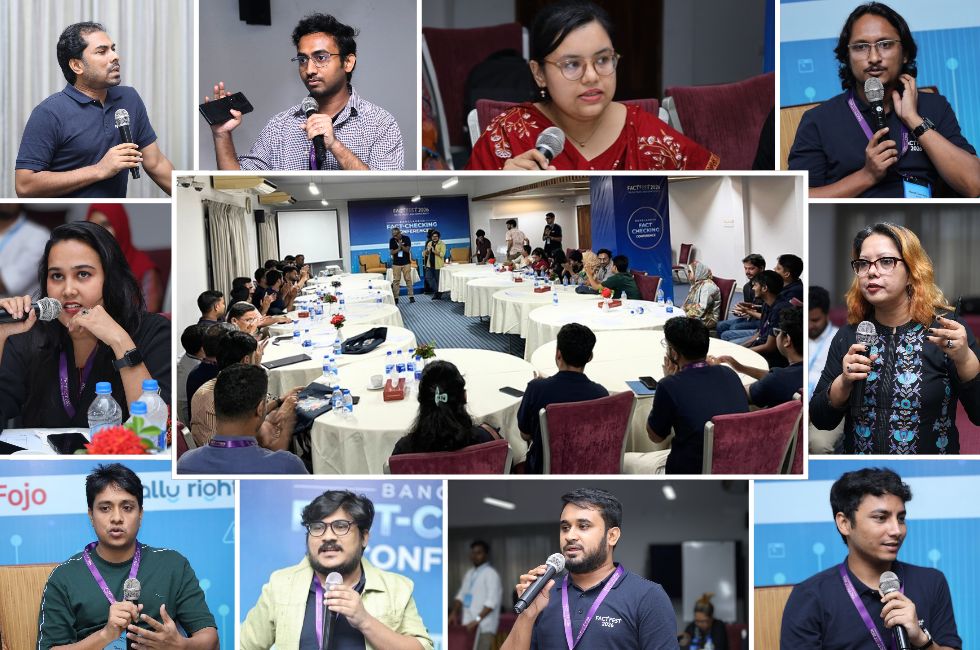
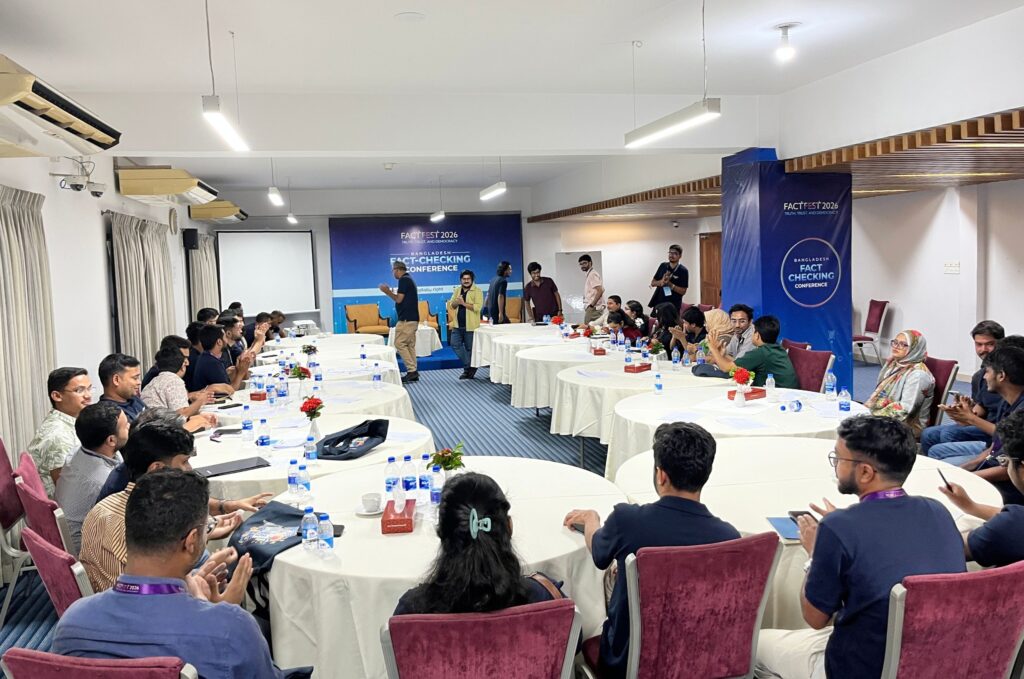
This growing professional and financial strain was the center of discussion at the concluding roundtable of the FactFest 2026 held on September 27–28, organised by Digitally Right under its Media Safety in the Digital Age project, in partnership with the Fojo Media Institute and with support from the Swedish International Development Cooperation Agency. It brought together around 100 fact-checkers, journalists, researchers, academics and students.
A total of 13 sessions explored political disinformation, religious extremism, gendered disinformation, information warfare, artificial intelligence, digital investigations, public trust and the future of fact-checking.
Videos of the sessions of the first day of the event were uploaded on Digitally Right’s YouTube channel.
Participants of the concluding roundtable titled “Building trust: Ethics and standards in fact-checking” pointed out that to remain credible and avoid any biases, fact-checking organisations often have to avoid traditional revenue streams such as advertisement or media partnerships.
However, the number of fact-checking organisations in Bangladesh has increased as opposed to the global decline, shared Shuvashish Das Ray Dip, assistant editor of FactWatch. And to sustain further, he said organisations need to diversify sources of revenue through research, media and information-literacy training and other services to create alternative funding opportunities.
Md Sakiuzzaman, co-founder of Rumor Scanner, also expressed apprehension over funding, noting that some organisations have already started laying off staff. He lamented, saying, “We are having to let go of fact-checkers who have been with us for several years due to budgetary constraints.”
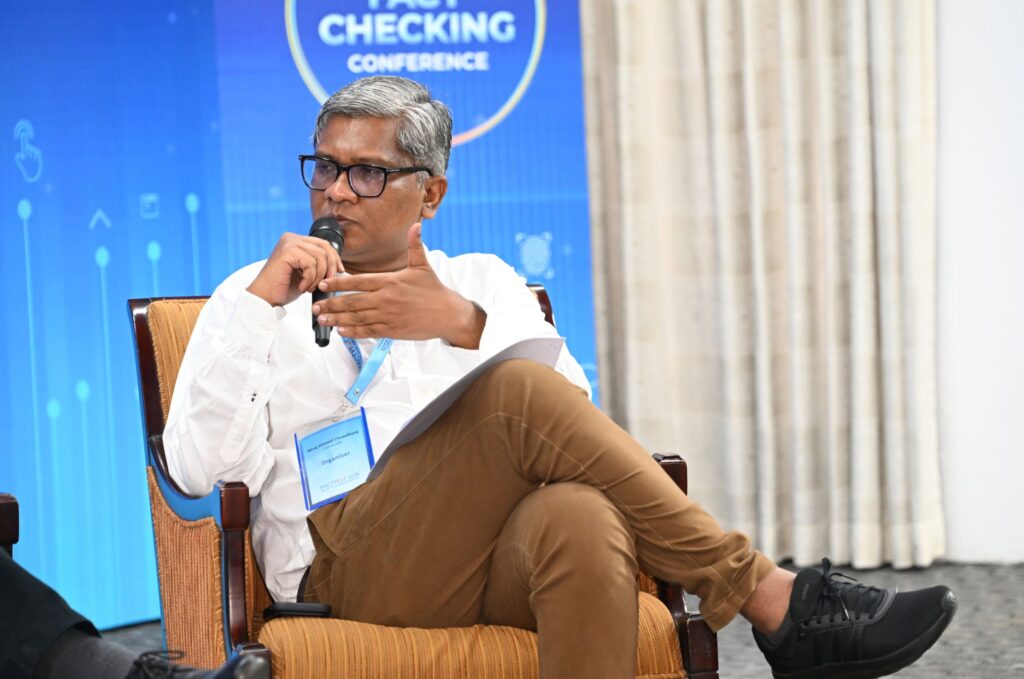
Miraj Ahmed Chowdhury, managing director of Digitally Right, said organisations need a mix of funding sources, including government and private-sector support, media literacy training, research and other services. Since conventional advertising is often not viable, he said, “We have to look at several sources.”
Miraj Ahmed Chowdhury, managing director of Digitally Right, said organisations need a mix of funding sources, including through private-sector support, grants, media literacy training, research and other services. Since conventional advertising is often not viable, he said, “We have to look at several sources.”
Uneven relationship with newsrooms
Another growing concern for the fact-checking community is the uneven relationship between fact-checkers and mainstream media, with some outlets increasingly embracing fact-checking while others remain reluctant to accept scrutiny, speakers said at FactFest 2026.
Azad Baig, digital growth editor of The Daily Star, said some media organisations are adding fact-checkers to their teams and reviewing reports before publication. While parts of mainstream media may view fact-checkers as unwelcome, he said responsible outlets would increasingly seek their advice to avoid errors.
Adnan Aziz, fact-checker at Media Resources Development Initiative (MRDI) called for a more constructive relationship, arguing that fact-checkers should act as “friends of the media.” Media organisations operate on a large scale and can make mistakes, he said, adding that fact-checkers should identify those errors without creating a hostile environment.
Md Sakiuzzaman of Rumor Scanner said collaboration remains limited despite efforts to work with around 25 online media outlets. Some organisations actively cooperate, while others remain unwilling, making collaboration a “multi-layered” challenge.
Saleh Fuad of Dhaka Stream said media organisations are now becoming more conscious of the need to take fact-checking into account. He suggested that while journalists should expect their work to be fact-checked, media organisations should also scrutinise the work of fact-checkers.
The discussion reflected a relationship that remains marked by tension but is gradually shifting towards greater awareness and, in some cases, collaboration.
Beyond debunking
Across the two days, one idea became increasingly clear: responding to misinformation is no longer only about proving whether a particular claim is true or false. It is also about understanding why narratives spread, who are the actors behind them, how they affect people and how verified information can reach audiences.
The role of fact-checkers in fighting against such narratives is important. FactFest was created to provide a space for Bangladesh’s growing fact-checking community to meet and discuss both existing and emerging challenges, shared Miraj Ahmed Chowdhury.
Opening the event, Swedish Ambassador to Bangladesh Nicolas Linus Ragnas Weeks spoke about the importance of information integrity during periods of political and social change. He stressed the role of journalists, civil society and fact-checkers in keeping credible information accessible, and the need for alliances and networks within the information ecosystem.
That broader question of how information shapes public life was explored throughout the conference.
During the session “Engineering Reality: Information Warfare and the Fragility of Trust in Democratic Transitions,” Dr Gregory John Simons, professor at Daffodil International University, asked whether information exists primarily to inform people or to influence them.
“If information is free to access, it is about influence. That’s the main point: you want to get your message across to an audience,” Simons said, while also pointing to the role of strategic competition, where actors use information to their advantage against an opponent or target.
Real-World impact and institutional realities
In a panel discussion on changing political dynamics, speakers examined how disinformation actors use tactics ranging from taking old media reports out of context to creating AI-generated crowds, fake leaks, fake accounts, doxxing and targeted harassment.
Minhaj Aman, research and policy lead at Activate Rights, argued that political actors cannot be viewed separately from the wider systems through which information is produced and distributed. He pointed to political parties’ use of state apparatus and networks to serve partisan interests.
That led to a broader discussion about whether the traditional claim-by-claim approach to fact-checking is enough as the consequences of misleading narratives can extend far beyond social media.
Meanwhile, a session on investigating religious extremism in Bangladesh’s online space examined how coordinated campaigns can move between online platforms and real-world communities. Investigative reporters and researchers discussed cases involving hashtags, extremist symbols and accusations of blasphemy.
Ahamed Yaseer Abrar, senior research officer at Dismislab, described how accusations of being “Shatim-e-Rasool” have been used to target individuals online. He said researchers found posts and groups compiling people’s photographs, addresses and phone numbers, while victims described living under constant fear after online accusations reached their communities.
Not only religion, gender is often used to target people in political and public life. At a session on gendered disinformation, Dismislab’s Noshin Tabassum said gendered disinformation has increasingly become a tool to silence women, with attacks focusing on their appearance, clothing and personal lives rather than their political positions and actions.
Tajnuva Jabeen, an organiser of political platform Alternatives, spoke about the growing use of AI to manipulate images of women. She said that while many women have developed resilience against such attacks, the consequences become particularly serious when families are targeted.
Anwara Parvin of FactWatch connected the issue to women’s participation in politics, arguing that fact-checkers alone cannot solve the problem. Policymakers, she said, also need to respond quickly when such campaigns emerge.
In another session, Swasti Chatterjee, deputy editor and project coordinator at BOOM, contributed a regional perspective on information manipulation and fact-checking. She said fact-checkers are increasingly having to move beyond traditional verification by adopting investigative reporting and on-the-ground verification.
The challenge is not only technological. Qadaruddin Shishir, editor of The Dissent, pointed to the limitations within newsrooms themselves. Many organisations lack the capacity for digital investigations, while investigations can become politically sensitive because they may affect someone’s reputation.
Call for meaningful law rather than vague restrictions under CSA
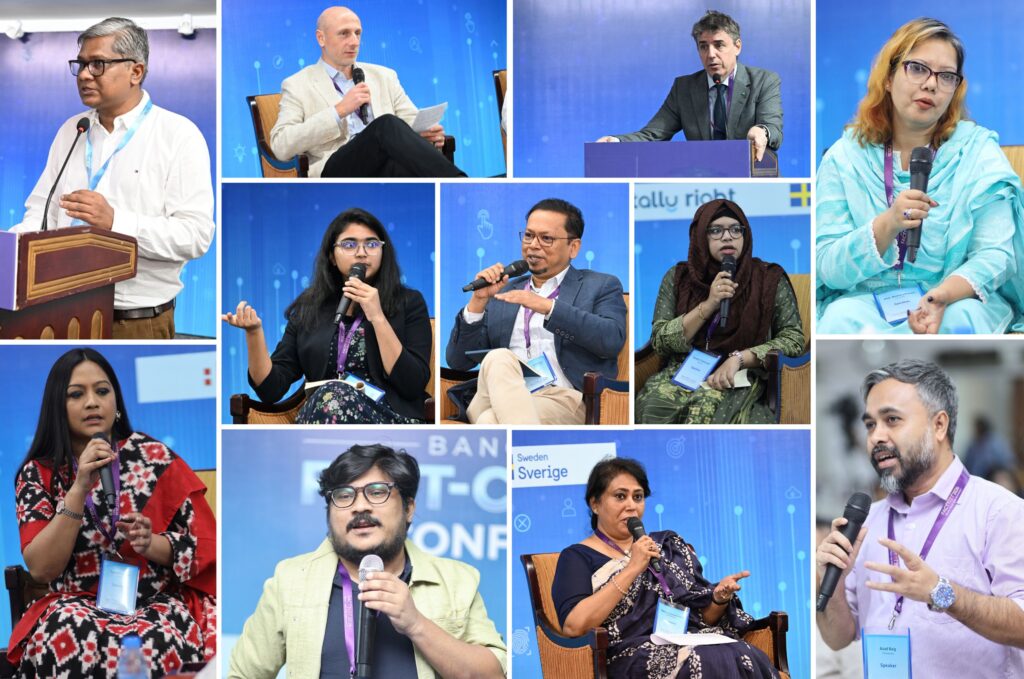
At the closing roundtable of FactFest 2026, fact-checkers, journalists and researchers also raised concerns over the proposed amendments to the Cyber Security Act 2026, particularly provisions that would criminalise defamation, “humiliation” and “bullying,” with penalties including prison terms and fines.
An investigative reporter at The Dissent cautioned that fact-checks themselves could be weaponised to target people if the law fails to distinguish between deliberately spreading harmful disinformation and reporting on it in the public interest.
Participants called for meaningful and clearly defined legal provisions to address harmful disinformation without creating vague restrictions that could affect legitimate journalism and fact-checking.
Navigating facts: ‘Making truth travel’
FactFest also looked beyond professional fact-checkers and asked how ordinary people—particularly young people—can become better equipped to navigate the information they encounter.
At a discussion on fact-checking and public trust, Tasnim Jara said children can learn to distinguish reliable information from falsehood if they are given the right tools. She argued that these skills should be taught not only at universities but much earlier, in schools.
“If children understand the whole ecosystem, we will be in a better society,” said Din M Sumon Rahman, dean of the School of Social Sciences and head of Media Studies. He also pointed out a difficult reality for fact-checkers: misinformation can travel faster because truth is not always the most attractive or shareable content.
That challenge of making truth compelling was at the heart of the keynote delivered by Paul Rapacioli, director of the Fojo Media Institute.
In “Making Truth Travel,” Rapacioli recalled how a routine Swedish technical and safety related decision about Christmas lights was transformed into a misleading story suggesting Sweden was trying to tone down its Christian traditions. The story illustrated why correcting misinformation is not always enough.
People may share misleading information because it confirms something they already believe, gives them an explanation for a problem or reinforces their sense of belonging to a community.
Urging fact-checkers to present evidence and investigations in a more compelling way, Rapacioli said, “Truth has to be established. Truth has to travel. And truth has to be trusted when it arrives,” he said.
That idea captured much of what the two days of FactFest explored.
The challenge facing fact-checkers is not simply to find the truth. It is to investigate how information is produced, understand the narratives that give it meaning, recognise the people and systems that amplify it, and communicate verified information in ways that audiences can understand and trust.