
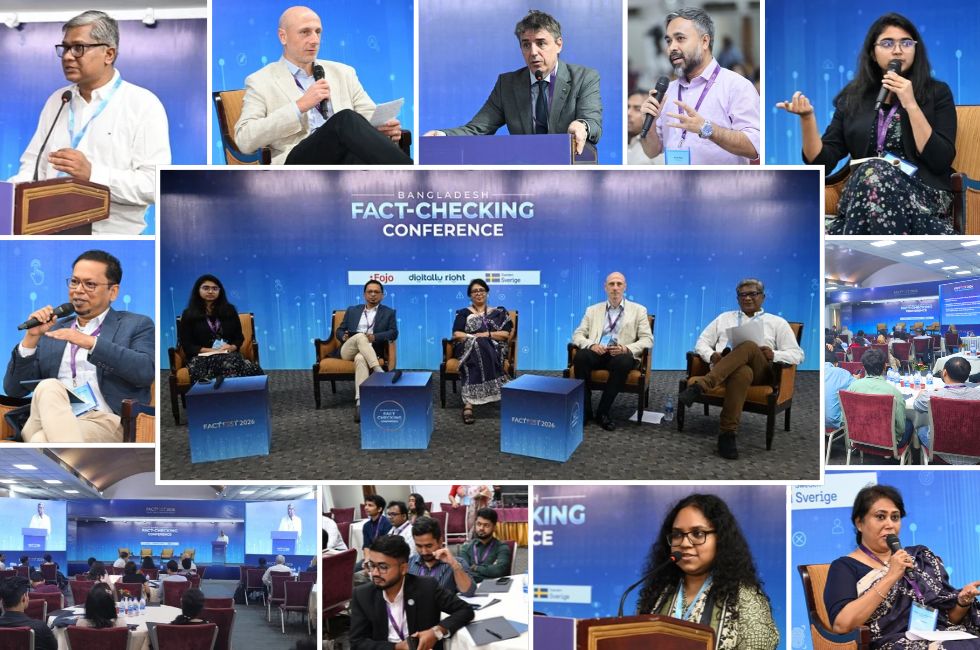
Children are growing up in an information ecosystem, but they are not being equipped with the tools to assess what is true and what is false. Society will only develop when children can understand and analyse the ecosystem as a whole, said speakers at FactFest 2026, organised by Digitally Right in partnership with the Fojo Media Institute under the Media Safety in the Digital Age project, with support from the Swedish International Development Cooperation Agency.
While speaking at a panel regarding the role of fact-checking in strengthening public trust Tasnim Jara, a doctor and a political personality, questioned what we are doing to make cyberspace safer for children.
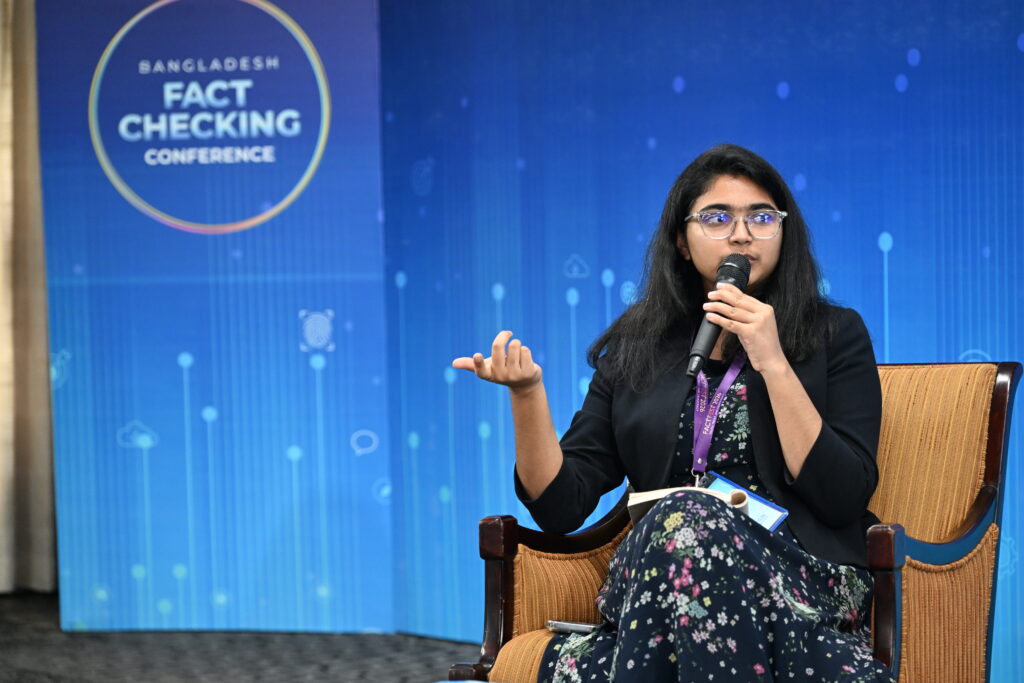
She highlighted that children can absolutely learn to use tools to differentiate between what is true and what is false.
The panel discussion was broadcast live on Facebook.
She cited studies which showed that if you give children simplified manuals and ask them, “Is this information reliable? Is this likely to be true? Is this likely to be not?”
“After equipping them with some skills, they can reliably discriminate between what is truth and what is falsehood. So this is something I think we need to teach, of course, in universities, but also lower down in our schools so that our kids can grow up with this awareness and also skills to be able to operate in today’s world,” said Jara.
Echoing the same, Din M Sumon Rahman, dean of the School of Social Sciences and Head of Media Studies, said, “If children understand the whole ecosystem, we will be in a better society.”
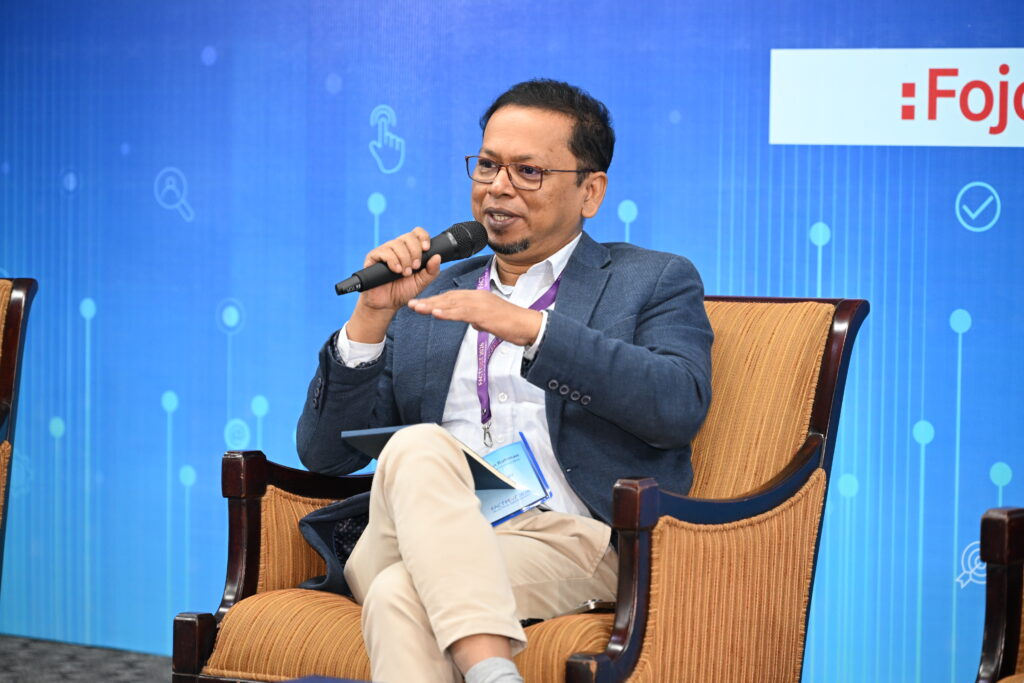
He also mentioned that misinformation can travel faster; truth is not very impressive, not preferable to many, which makes the job of fact-checkers very difficult. So, fact-checkers have to present the facts in a more palatable way, which attracts the attention of people, he added.
Trust, AI and the challenge of fact-checking
He also touched on artificial intelligence and said there should be separate laws on AI rather than a short segment inside the Cyber Security Law.
Another speaker on the panel, Sheela Tasneem Haq, senior governance specialist at UNDP Bangladesh, also talked about AI. She said, “Amid the emergence of deepfake news, a lot of fact-checkers that we work with are struggling to ensure the ethical use of AI along with the whole effective understanding of the institution (democratic institution). The critical question has become how the pathway of change will evolve and how trust will be ensured.”
“Democracy is all about trust. And, the trust, of course, is related to the truth. But truth is something that you act upon, you believe in it, and you sort of take it inside. If the trust is not there, the democratic institute needs to be revisited,” she added.
Another speaker, Paul Rapacioli, director of the Fojo Media Institute, said, “Today, everybody with a mobile phone or social media account is an editor to some extent. The previous gatekeepers of information nodes had so much training in terms of information integrity.”
“We need to use humor. We need to use compelling stories. Storytelling is also part of human nature… What we are fighting against is human nature. We should not underestimate the need to sell yourself. I don’t think we should dismiss that as being cheapening our facts, cheapening our truth. I think there’s a tendency with the purer the product, whatever it is, there’s this feeling that we need to sell it so hard because it’s the purer product of itself.”
‘Truth has to travel’
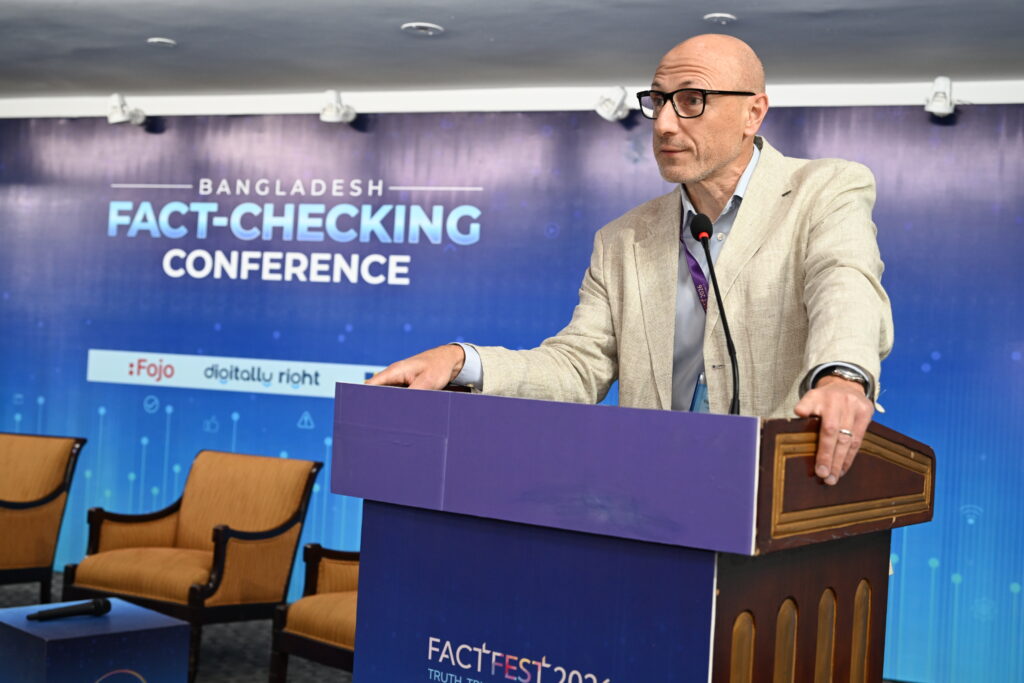
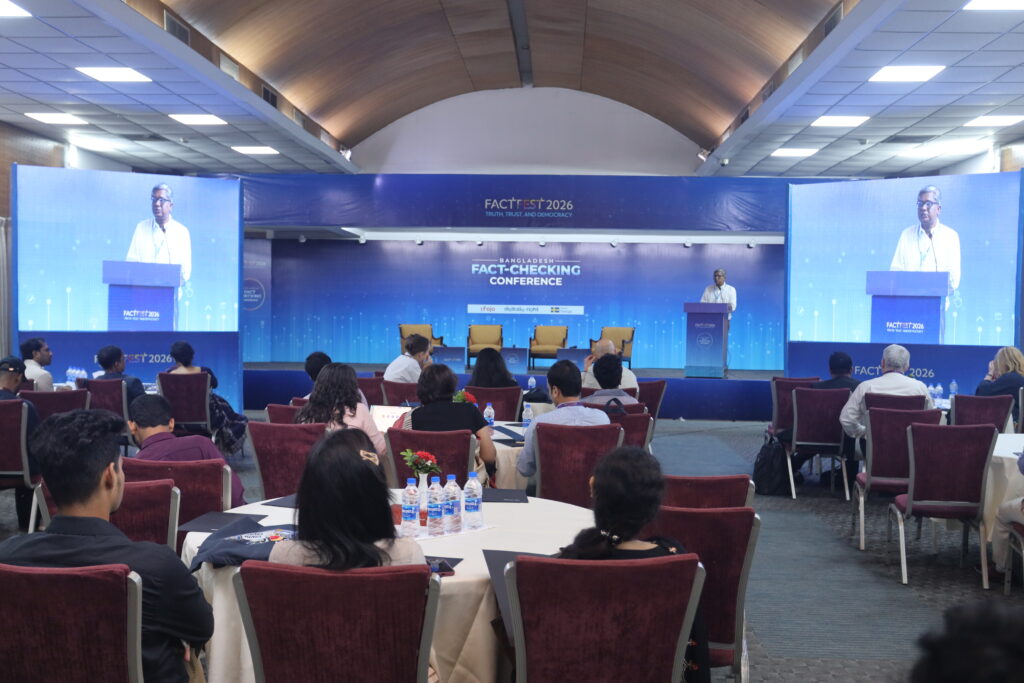
Fact-checking is no longer only about establishing what is true; it is also about finding ways to make verified information reach audiences and earn their trust, said Paul Rapacioli, director of Fojo Media Institute, in his keynote at FactFest 2026.
Delivering the keynote, titled “Making Truth Travel,” Rapacioli reflected on how the information environment has changed over the past decade and why fact-checkers need to think beyond simply correcting false claims.
Paul said, “On this particular November afternoon in 2016 I was sitting in a café near my office when I received an email from a reader of The Local. He was writing from England and he wanted to know if it was true that Sweden had banned Christmas lights.
“Now, I didn’t need to do much fact-checking. I just had to look out of the window to see a whole street full of Christmas lights sparkling in the November gloom. I wrote back to him and told him, no, Sweden had not banned Christmas lights. But I was curious to know where this strange – and obviously untrue – idea had come from.”
A Swedish public broadcaster reported a routine local decision by the Swedish Transport Administration that Christmas lights could no longer be hung from certain lamp posts due to technical, legal and safety reasons.
The story was unremarkable until a small news website translated it into English. But they added a sentence suggesting that the decision was really about religion, about toning down Sweden’s Christian traditions.
Although the original decision had nothing to do with religion, but that became the message that travelled through websites, blogs and social media, reaching an audience hugely larger than the original report.
Rapacioli shared what followed: “The fact-checking website Snopes debunked it. A Swedish fact-checking team produced a video explaining what had actually happened…At The Local, we invited readers to send us photographs of Christmas lights in their towns.
“We got a lot of photographs! And then for years afterwards we ran a humorous piece about how Sweden still hadn’t banned Christmas lights.”
For Rapacioli, the episode demonstrated how a small piece of truth can be removed from its context, given a new meaning and turned into something entirely different.
“The fact-checkers’ video and our readers’ photographs were attempts to do something more than correct the record. We were trying to give people something worth paying attention to – and perhaps something to share themselves,” he added.
The keynote also explored why people share misleading information. Rapacioli noted that people may be drawn to information because it connects something real to beliefs they already hold, provides an explanation for their problems or confirms their sense of belonging to a particular community. As a result, a fact-check may correct a claim without addressing the reason it appealed to someone in the first place.
He urged fact-checkers to think creatively about how they present evidence, arguing that a good investigation can itself become a compelling story by showing audiences not only what is true, but how that conclusion was reached. “Truth has to be established. Truth has to travel. And truth has to be trusted when it arrives,” he said.
Rapacioli also highlighted the growing influence of social media platforms and content creators in determining how people encounter news. Artificial intelligence presents another shift in how audiences access verified information, he added. AI assistants can summarise or assess news and sources without users necessarily seeing the original evidence. This creates a new challenge for fact-checkers: they may conduct detailed investigations while an AI system becomes the intermediary that presents their findings to audiences.
He concluded by emphasising the value of collaboration among fact-checkers, journalists, researchers and open-source intelligence practitioners. Methods, tools and investigative findings can be shared across organisations and borders, allowing professionals to respond to an information environment that increasingly crosses languages and national boundaries.
Building a fact-checking community
The event opened with remarks from H.E. Nicolas Linus Ragnas Weeks, Ambassador of the Embassy of Sweden in Bangladesh; Miraj Ahmed Chowdhury, Managing Director of Digitally Right Limited; and Maria Petersson, Project Manager, Bangladesh, at Fojo Media Institute. They welcomed participants to Fact-Fest 2026 and highlighted the importance of bringing together fact-checkers, journalists, researchers and other stakeholders to exchange experiences and strengthen efforts to address misinformation and disinformation in Bangladesh.
Miraj Ahmed Chowdhury, managing director of Digitally Right Limited, highlighted the importance of creating a fact-checking community for exchanging experiences and strengthening efforts to address misinformation and disinformation in Bangladesh.
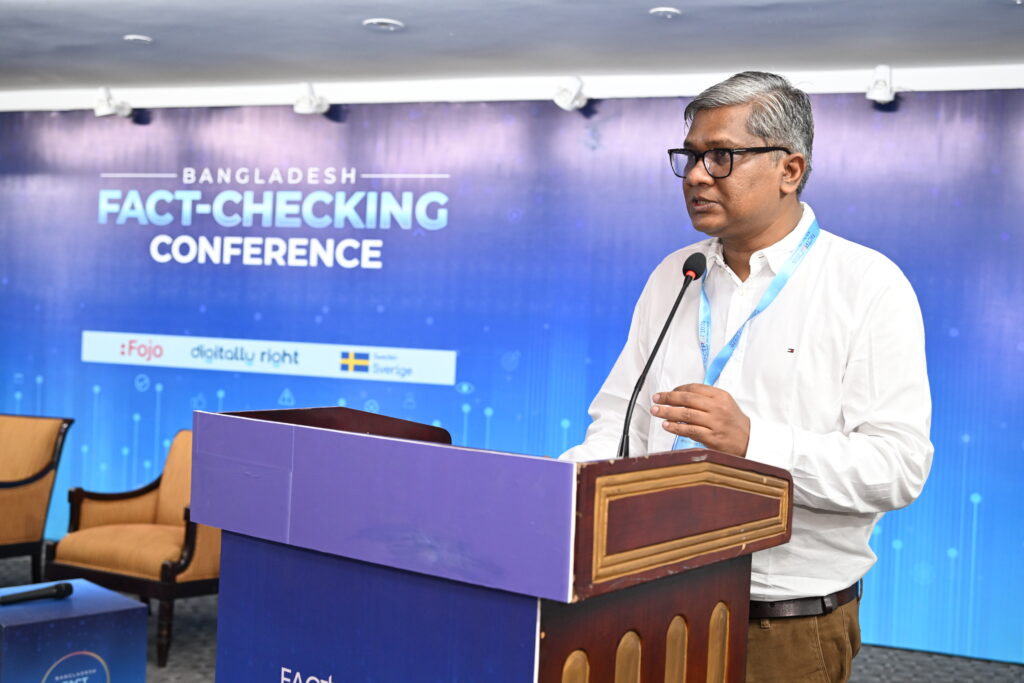
“In many countries, fact-checking started as an offshoot career. But in Bangladesh, this started as an independent career and community. FactFest was started to build a community. FactFest is preparing the ground to talk about emerging and existing problems,” Miraj Ahmed said.
“We welcomed students to build this community even stronger. So that they can meet fact-checkers and build an even stronger network of fact-checkers.”
Pointing out the increasing number of fact-checkers in the country, Miraj Ahmed said, “We could not even gather 35 fact-checkers for the last FactFest, but this year we have gathered over 80 fact-checkers from across the country.”
Maria Petersson, Project Manager, Bangladesh, at Fojo Media Institute, welcomed the guests by saying, “We are really proud to be a part of FactFest. We have worked with fact-checking in Sweden and Bangladesh. I am looking forward to the two days of FactFest 2026.”
In his opening remarks, Nicolas Linus Ragnas Weeks, ambassador of the Embassy of Sweden in Bangladesh, said, “We gathered here at a moment when Bangladesh is facing a fragile political shift, and it concerns disinformation and the information environment that we live in, with the echo chambers that can obscure public space.
“In this environment, the world of fact-checkers and information integrity is important to have FactFest. Building alliances and networks is important for credibility.
“Sweden’s commitment is that every person must have access to information and be protected from misinformation and disinformation. This approach is rooted in non-discrimination and accountability. Especially for those who are vulnerable to exclusion,” he said.
Media and civil society have a collective responsibility to uphold these values. Journalists can report facts and investigate wrongdoing without fear. People are more likely to trust this information and trust journalists as a proper guide to public life. Citizens can feel more confident that the information they are receiving is more credible.
“Disinformation based on gender is rooted in traditional norms and it can legitimise undermining women’s participation in public life. No one can defend this information alone. We are in this together,” he added.