
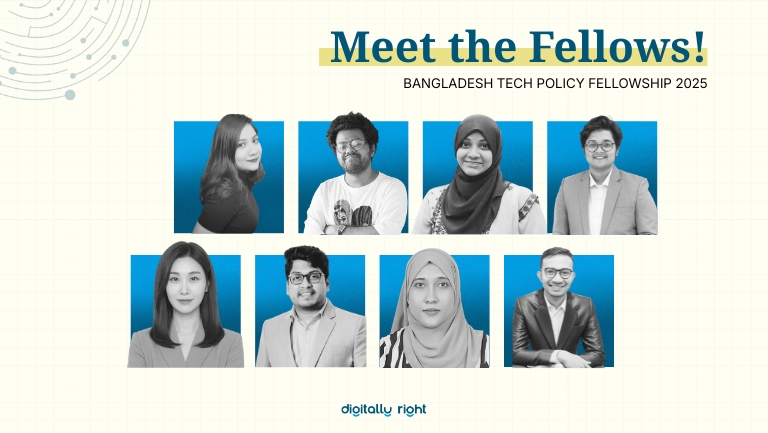
As technology increasingly shapes how we communicate, access information, and participate in society, understanding the policies that govern digital spaces has never been more important. The Bangladesh Tech Policy Fellowship provides a platform for emerging professionals to engage deeply with these challenges and contribute to shaping a more open, inclusive, and rights-respecting digital environment.
Digitally Right organizes the Tech Policy Fellowship annually to advance research and dialogue in this field. This year, the fellowship expands beyond Bangladesh to take a broader regional perspective. The Tech Policy Fellowship 2025 focuses on the evolving landscape of media regulation, internet governance, and digital rights challenges across South and Southeast Asia.
In this cohort, we welcome eight young passionate fellows from three countries, Bangladesh, Indonesia and South Korea, coming from the fields of law, academia, and civil society.
Fellows from Southeast Asia are paired with fellows from Bangladesh to form collaborative research teams to encourage regional exchange and joint learning. Each pair will work together to map shared challenges, policy gaps, and social contexts affecting people and communities in their respective countries.
Meet The Fellows
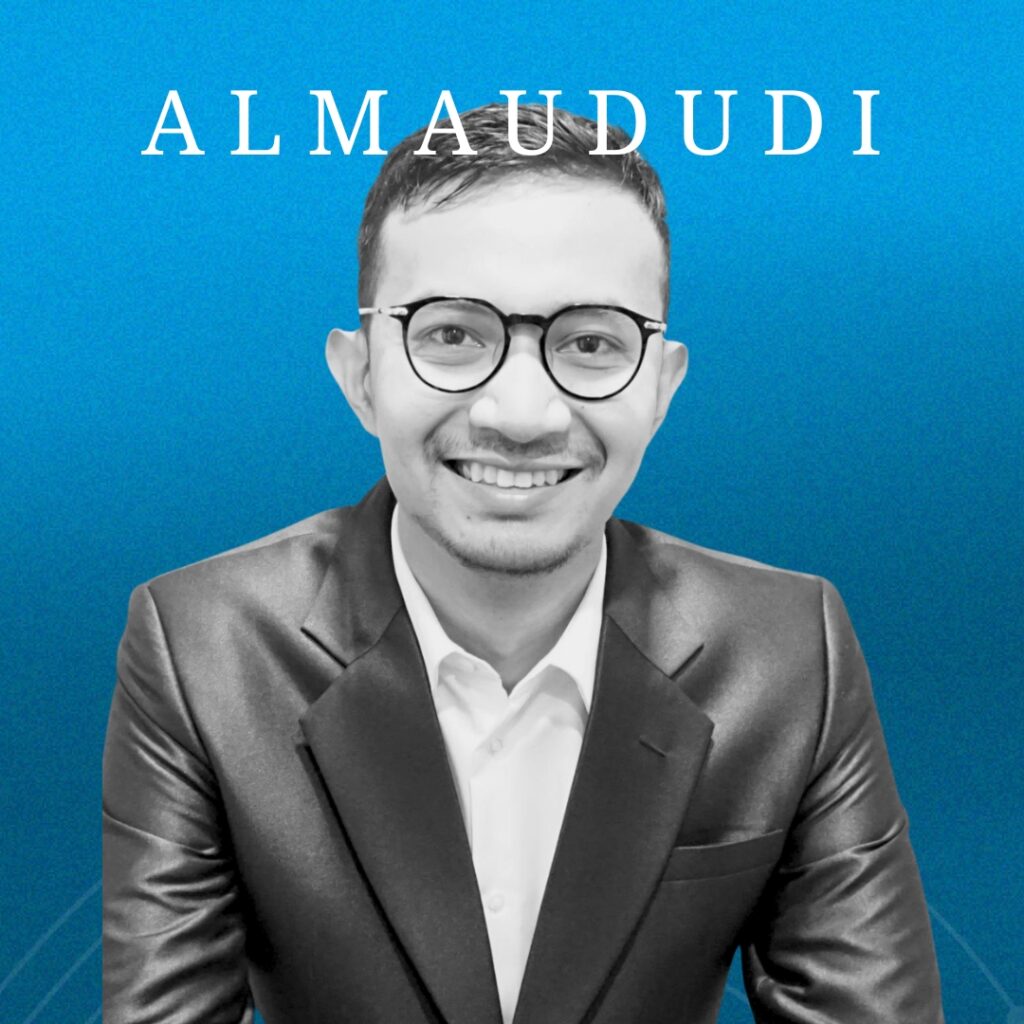
Almaududi (Dudi) is an Assistant Professor at the Faculty of Law, Universitas Andalas (Indonesia), and is currently pursuing his doctoral studies at Faculty of Law Universiti Malaya (Malaysia). Before entering academia, he built a professional legal career as lawyer at prominent law firms in Indonesia such as the Law Offices of Prof. Dr. Sutan Remy Sjahdeini, SH. Dudi also has experience in Legal and Industrial Relations multinational companies, including PT. Home Credit Indonesia. Dudi’s recent research bridges the gap between traditional law and the digital age, with a focus on civil procedural law, financial law and technology.
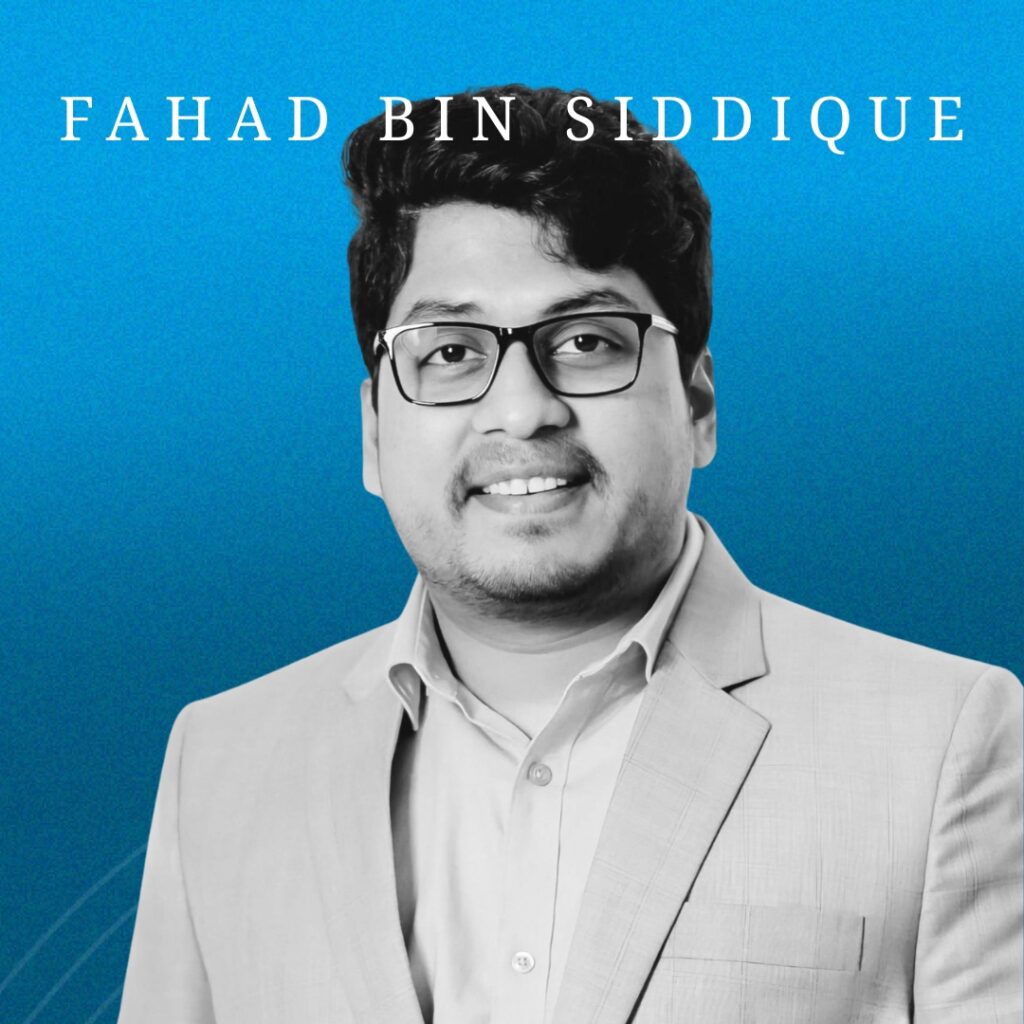
Fahad Bin Siddique serves as a Senior Research Officer at Bangladesh Legal Aid and Services Trust (BLAST). Previously, he held research fellowships at BLAST and the Tech Global Institute. His research interests include intellectual property law, human rights law, climate change law, the rights of marginalized communities, and the intersection of legal theory and technology studies. In addition to his experience as a commercial lawyer working with several chambers, he has authored multiple journal articles and book chapters on climate change law, intellectual property law, and human rights law.
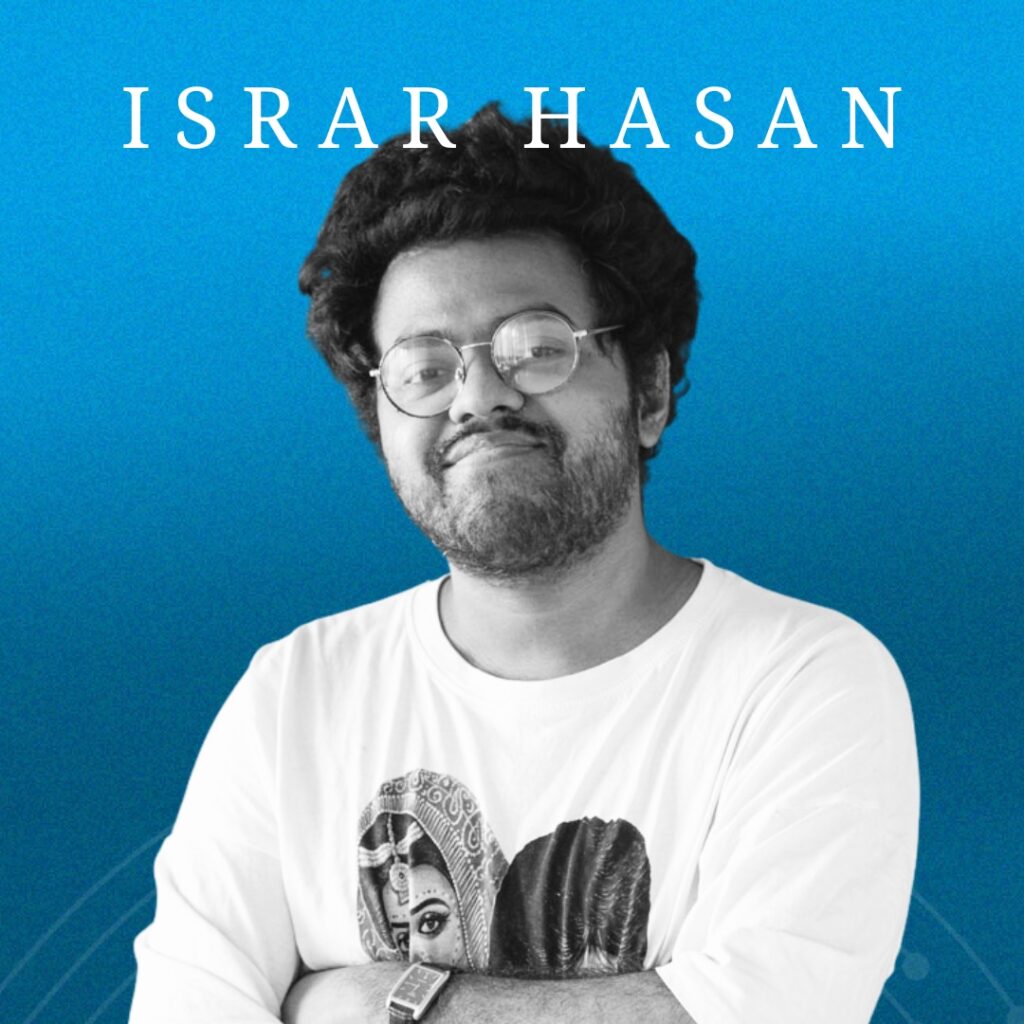
Israr Hasan is a public health researcher working at the intersections of gender, climate change, mental health, and social movements. He completed his undergraduate degree, majoring in Economics with a minor in Anthropology, from BRAC University, Bangladesh.
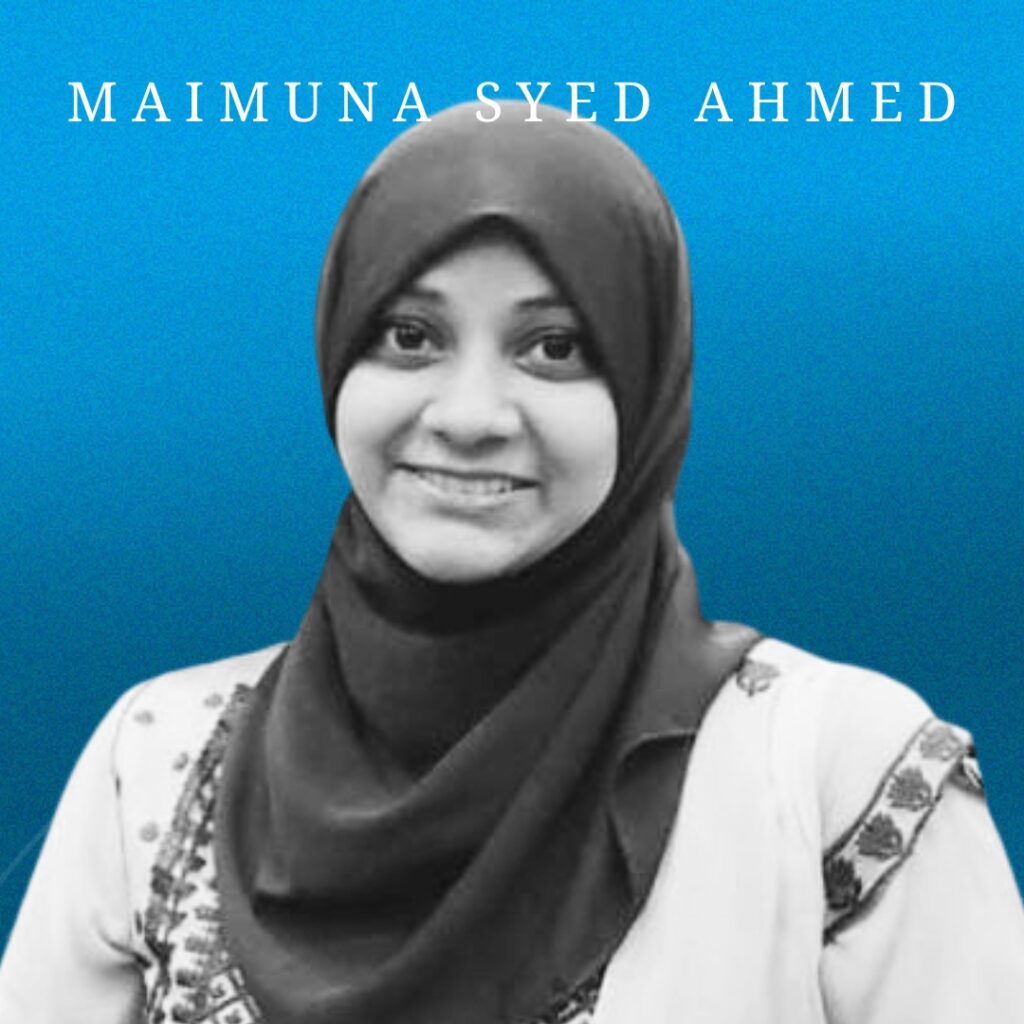
Maimuna Syed Ahmed is currently a faculty at the School of Law, Independent University, Bangladesh (IUB). Previously, she worked as an Assistant Coordinator at Ain o Salish Kendra (ASK). She was awarded her MSc in Human Rights from the London School of Economics and Political Science (LSE) as a Chevening Scholar. Her area of research interests range across the fields of Criminal Justice System, Human Rights, Constitutional Law, Technology Jurisprudence and Public International Law.

Mika (Jaeyun) Noh is a cultural policy strategist and researcher working at the intersection of artificial intelligence, digital governance, and the creative economy. With over fifteen years of experience across legislative research and cultural policy, she examines how emerging technologies reshape cultural institutions, creative labor, and public governance. She is the founder of AI Culture Lab, an initiative exploring human-centered AI governance and cultural data stewardship. Her work focuses on helping governments and cultural organizations navigate questions of digital rights, cultural sovereignty, and the future of creativity in the AI era.
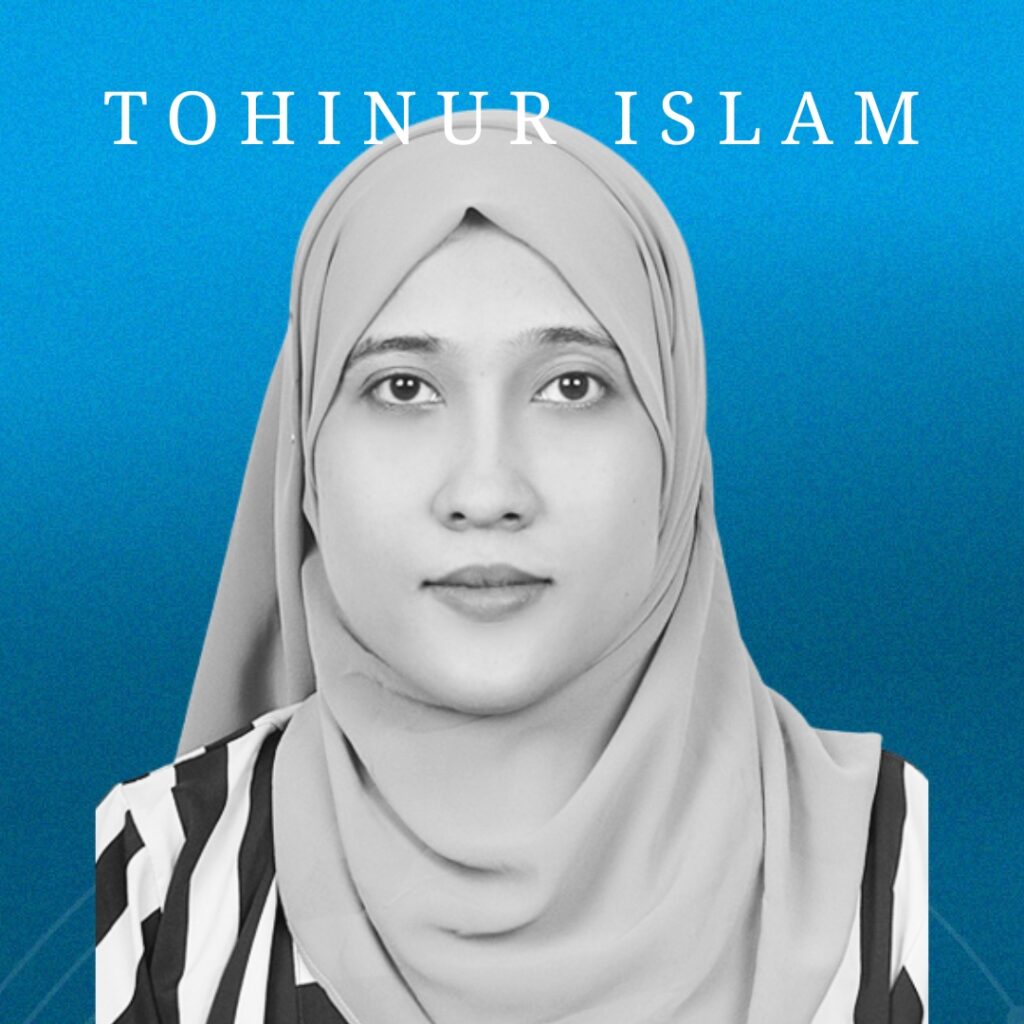
Ms Tohinur Islam serves as the Executive Director and Co-Founder of Map of Justice, an independent, non-governmental, non-political, non-partisan, and non-profit youth-led think tank based in Bangladesh. Through this platform, she works to advance socio-legal awareness by leading research, advocacy, and capacity-building initiatives, particularly in the fields of technology and cyber law, environmental law, constitutional law, Muslim family law, and international law.

Nadia Rahman is a faculty member in the Department of Mass Communication and Journalism at Bangladesh University of Professionals, Dhaka, Bangladesh. She has been involved in academia for nearly eight years. Rahman’s research interests include artificial intelligence in newsrooms, media development in the Global South, and health communication. She also writes opinion pieces on contemporary education and media issues in Bangladesh.

Trish Mallick is a public health researcher working on health systems, equity, nutrition, and population wellbeing. Trish focuses on generating evidence to improve access to quality health services and to better understand the social factors that influence health outcomes, particularly in low and middle income countries. Beyond research, Mallick is deeply committed to gender equality and human rights. He actively supports youth engagement and social justice initiatives that aim to build more inclusive and equitable societies.