
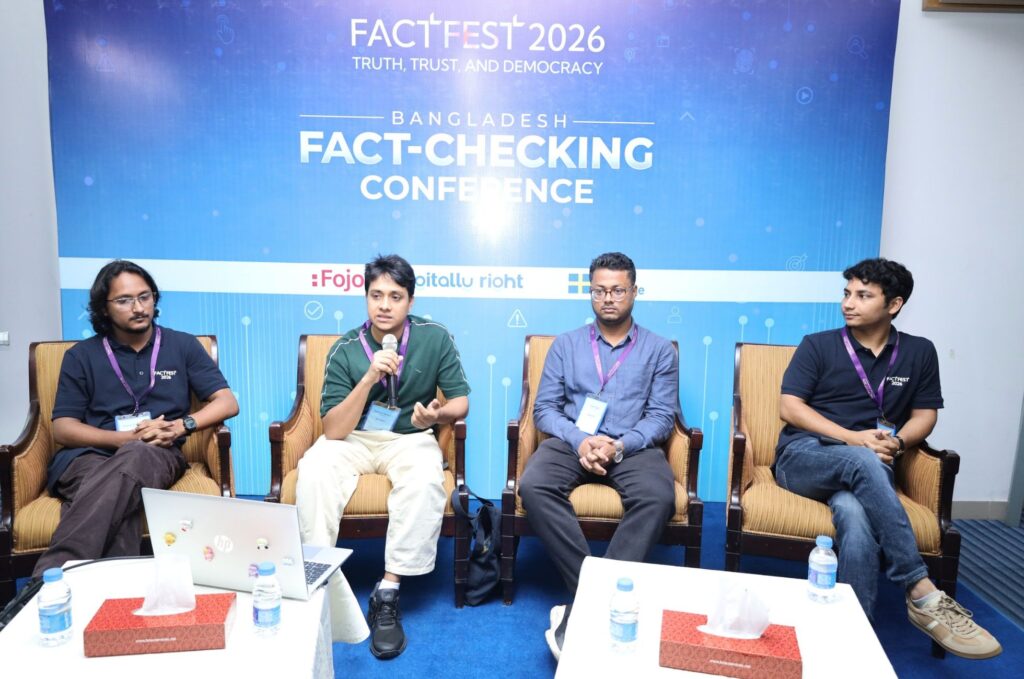
The growing use of social media to spread religious extremist narratives presents new challenges for journalists and researchers investigating online activity in Bangladesh. At FactFest 2026, organised by Digitally Right, a panel titled “Investigating religious extremism in Bangladesh’s online space” brought together investigative reporters and researchers to explore how radical narratives are created, amplified, and disguised as organic social media trends.
The panel featured Hasan Al Mahmud, investigative reporter at The Dissent; Saleh Fuad, senior reporter at Dhaka Stream; and Ahamed Yaseer Abrar, senior research officer at Dismislab, moderated by Shuvashish Das Ray Dip, assistant editor at FactWatch. The discussion illuminated how radical propaganda transitions seamlessly between online ecosystems and real-world violence.
Dissecting TMD: Online hashtags and real-world impact
Hasan Al Mahmud, investigative reporter at The Dissent, opened the discussion by detailing an investigation into the TMD hashtag campaign, which surged across social media following the killing of Advocate Saiful Islam Alif in Chattogram. “The campaign operated under a covert double meaning: while framed online as part of a campaign demanding a ban on ISKCON, cross-border analysis in India revealed that the TMD hashtag originally stood for the violent, anti-Hindu slur ‘Total Malaun Death.’ When challenged, actors behind the campaign claimed the acronym stood for ‘Total Mishti Distribution’ (sweet distribution).”
“The campaign was designed to incite communal unrest, with posts actively calling for riots in regions like Noakhali,” Hasan Al Mahmud explained. “By validating data across both Bangladesh and India, we traced how online pressure was being converted into offline mobilisation. Through investigative reporting, we published the names and photographs of the key perpetrators behind the campaign. Their subsequent arrests effectively dismantled the hashtag network, neutralising a plot that could have sparked widespread communal violence.”
Normalizing extremist symbols: The Kalima Flag Movement
Saleh Fuad, senior reporter at Dhaka Stream, highlighted a coordinated effort to normalise radical iconography across public infrastructure. Following June 17, calligraphic flags featuring the Kalima—historically associated with Taliban and Al-Qaeda networks—suddenly appeared across major bridges, flyovers, and elevated expressways in Dhaka and Chattogram.
“When police removed initial flags placed on the Jatrabari flyover by youth celebrating the Arabic New Year, activists went live on social media, declaring a nationwide campaign,” Saleh Fuad reported. “Our investigation revealed that this was not a spontaneous religious gesture, but an organized campaign led by radical groups—including actors linked to Hizb ut-Tahrir and Al-Qaeda affiliates—often responding to calls by figures like Harun Izhar.”
Saleh Fuad also disclosed investigative findings regarding covert gatherings. He said, “We obtained an invitation card for an event intended for 650 individuals, disguised as a business conference. Our background checks revealed that nearly every attendee had prior ties or charges related to militant activity, including past travels to Afghanistan. Furthermore, senior Taliban figures had quietly toured local madrasas. Despite formal diplomatic inquiries sent to the Afghan Embassy and local authorities, official channels remained silent, even as radical organisations coordinated logistical support.”
Weaponizing doxxing: The ‘Shatim-e-Rasool’ label
Ahamed Yaseer Abrar, senior research officer at Dismislab, presented findings on the weaponization of the term “Shatim-e-Rasool” (blasphemer) on social media. Since late 2024, Dismislab tracked over a hundred posts and dedicated groups systematically compiling targeted individuals’ personal photographs, home addresses, and phone numbers to incite mob violence.
“Meta had no specific policy addressing ‘Shatim’ allegations in local contexts, though Urdu keywords face moderation, as they mentioned,” Ahamed Yaseer Abrar noted. “Our team mapped these networks layer by layer, eventually tracing an active group back to an admin of the group. While initially he responded to our questions, he ceased communication upon discovering our affiliation with Dismislab. We also conducted in-depth interviews with victims who faced severe real-world consequences.”
Ahamed Yaseer Abrar emphasised that accuracy is rarely a factor in these attacks. Many targets were labeled based on fabricated or edited screenshots rather than genuine statements.
Abrar said, “Simply labeling someone tomorrow as a ‘Shatim-e-Rasool’ (blasphemer) is enough to trigger widespread circulation (spread of a social media post). People do not bother to verify whether suppose Subhashish or Ifaz actually made the statement. Fact-checking is irrelevant to them—they accept it as truth simply because someone else claimed it, and it keeps circulating.
“Eventually, this online circulation reaches the victim’s local community, inciting real-world hostility. During our interviews, two victims revealed that they literally did not leave their homes for a month. They lived under constant psychological trauma.”
“One victim recalled, ‘I live in constant fear—wondering if the person walking past me is going to stab me.’ Or sitting at a tea stall, if a stranger sits nearby, their mind immediately races, ‘Why did this stranger sit next to me?’ It traps the victim in a state of continuous, paralysing fear under immense societal pressure,” added Abrar.
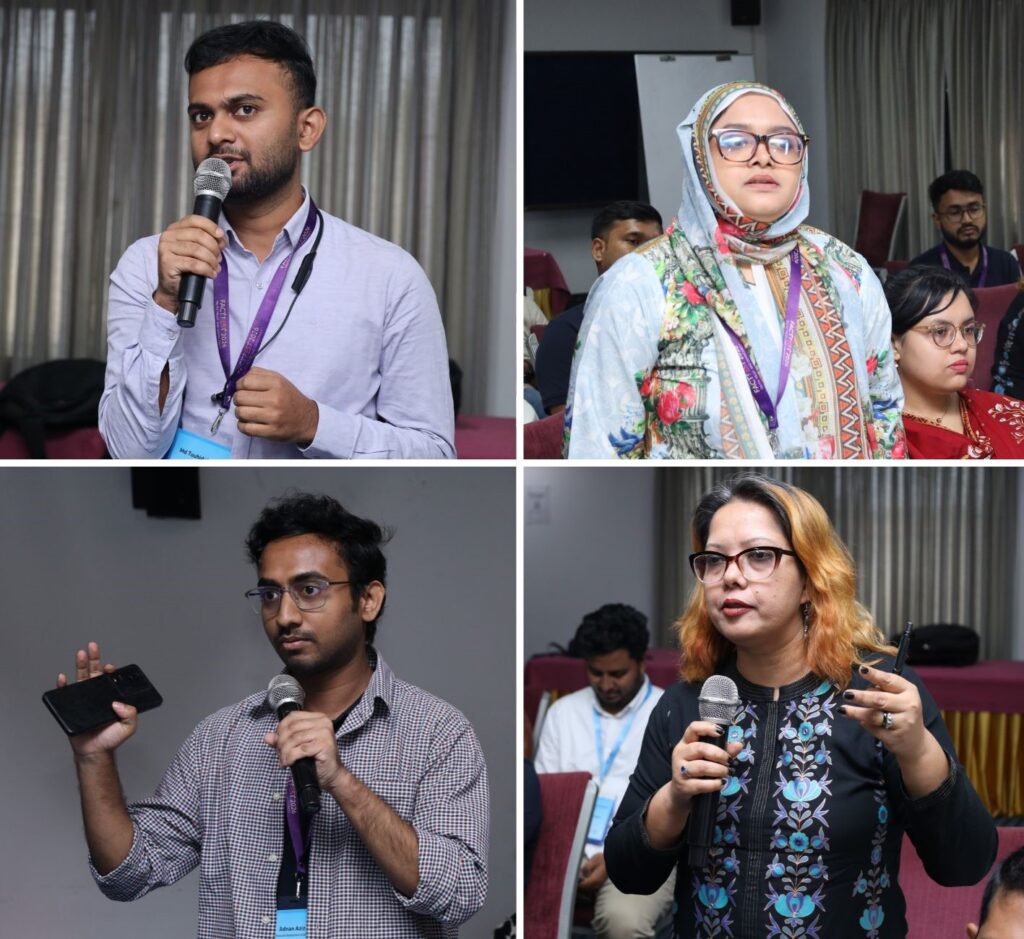
There was in depth discussion between the audience and the speakers over the different risks of religious violence incited through social media. Questions also arose over what the social media platforms are doing to obstruct such incitement.
The session concluded by addressing the systemic gaps that allow extremist campaigns to flourish online; how such campaigns can be identified and thwarted.