
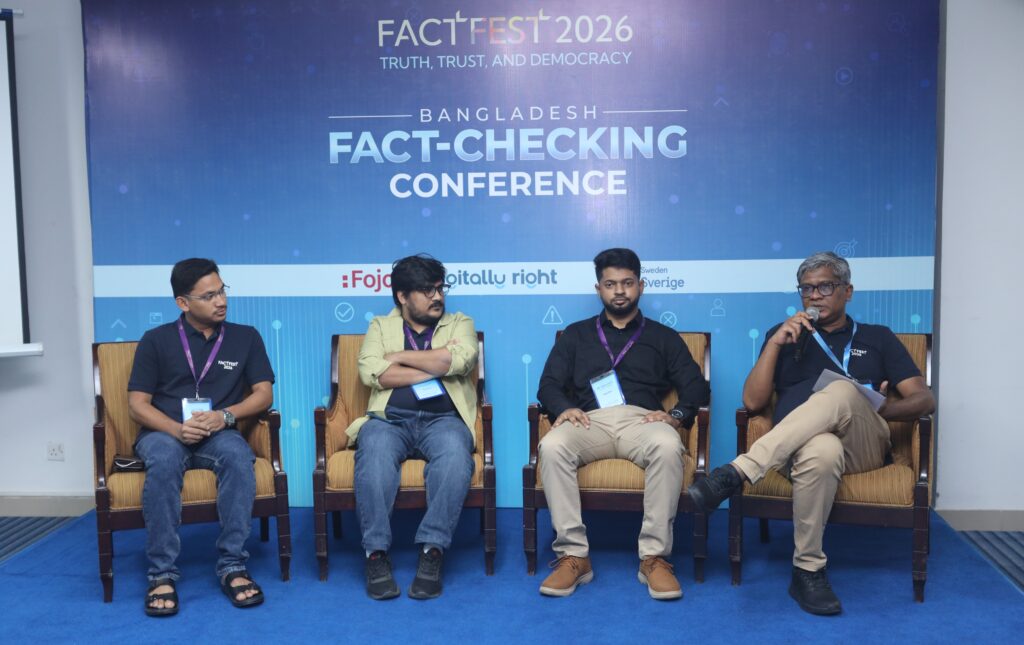
The traditional playbook for verifying information is failing against increasingly sophisticated propaganda networks, media experts and fact-checkers warned at FactFest 2026, organised by Digitally Right in partnership with the Fojo Media Institute under the Media Safety in the Digital Age project, with support from the Swedish International Development Cooperation Agency.
During a panel discussion titled “Follow the actor: Disinformation in the changing political dynamics”, three fact-checkers with experience tracking political disinformation examined how different actors produce, spread and use misleading information during a period of political change.
The panel featured Minhaj Aman, research and policy lead at Activate Rights; Tausif Akbar, senior fact-checker, Boom Bangladesh, and Sakiuzzaman, co-founder of Rumor Scanner, bringing together perspectives from research, policy and fact-checking on Bangladesh’s changing political disinformation ecosystem. The discussion was moderated by Miraj Ahmed Chowdhury, managing director of Digitally Right Limited.
Discussion arose over how disinformation actors should be identified or how their political identities can be ascertained.
How digital manipulation evolved
Opening the session, Sakiuzzaman, co-founder of Rumor Scanner, outlined 10 distinct behavioral tactics deployed by Awami League-aligned online actors. These strategies range from weaponizing older media out of context, generating artificial intelligence (AI) crowds, and staging fake leaks to doxxing opponents and orchestrating targeted harassment under disguised identities.
However, Minhaj Aman, research and policy lead at Activate Rights, emphasized that focusing solely on political factions misses the larger threat: the enduring power of state infrastructure.
“You cannot isolate political actors from state mechanisms,” Minhaj Aman noted. “While opposition actors lack scale and often face institutional barriers when spreading rhetoric, the state possesses an active, large-scale ecosystem capable of weaponising information. The networks established under previous administrations—spanning bot operations, fake accounts, and covert organizations—remain intact and ready for revitalization.”
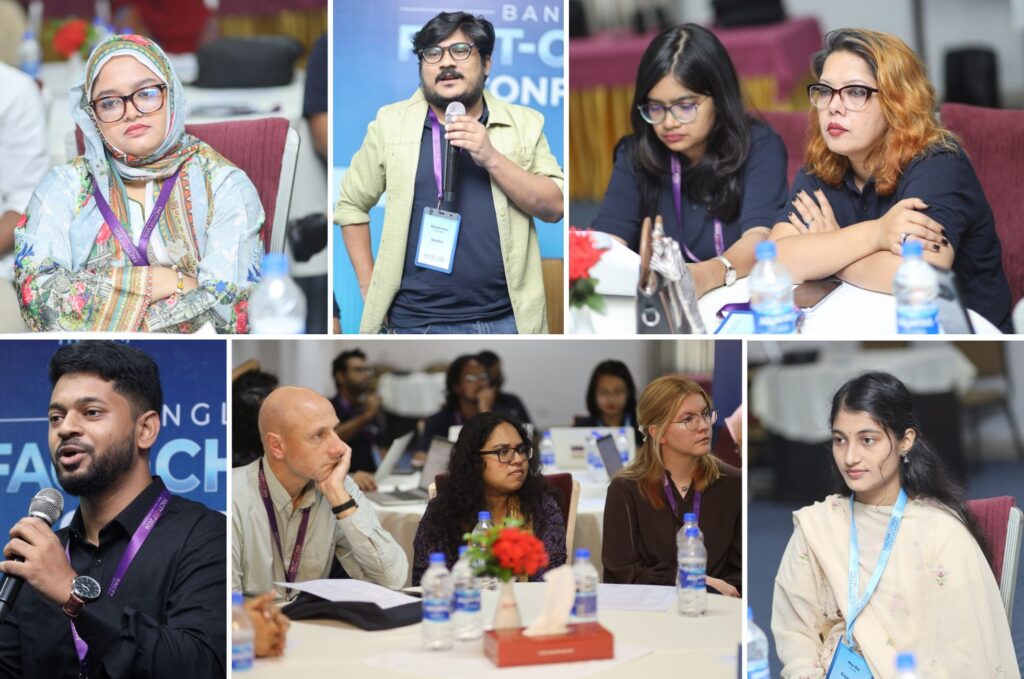
Minhaj pointed out that official government outlets, press wings, and state agency communication channels continue to amplify inaccurate or fabricated claims, demonstrating how deeply embedded these mechanisms remain.
Tausif Akbar, senior fact-checker, Boom Bangladesh, observed, “Historically, disinformation has circulated far more heavily against those in power. However, we are now seeing a somewhat different picture. Today, actors aligned with both the ruling party and opposition groups are generating and spreading disinformation at roughly equal levels.”
Shifting focus: From claims to overarching narratives
A central theme of the panel was the need to overhaul how fact-checkers operate. Rather than treating misinformation as a series of standalone incidents, experts urged researchers to trace the master narratives behind them.
Aman highlighted research analyzing over 2,500 fake news items circulated during the interim government’s tenure. Despite the massive volume, the content was engineered around just four core narratives designed to undermine stability and manipulate public perception.
“Verifying a single screenshot or debunks in isolation no longer serves the public,” Minhaj argued. “If we do not dismantle the underlying narrative an operation serves, our efforts remain fragmented.”
The panel also addressed the practical challenges of tracking digital actors. When discussing monitoring strategies, speakers emphasised hands-on tracking over complete reliance on automated software or newsfeeds. Effective monitoring requires continuous observation of daily political developments, key actors, argument shifts, and comment sections.
Assigning researchers to specific political spheres helps teams anticipate narrative shifts before fake news goes viral.