
For Mong Sing Hai Marma, a district correspondent for The Daily Star based in the hilly tracts of Bandarban, the dangers of the profession are etched into the rugged landscape itself. In the Chittagong Hill Tracts, reporting is not merely a matter of finding a story; it is a delicate negotiation with physical and digital safety. “We have to move with a lot of security concerns,” Marma said. “If things go a little this way or that, it takes a terrible turn toward a threat to life”.
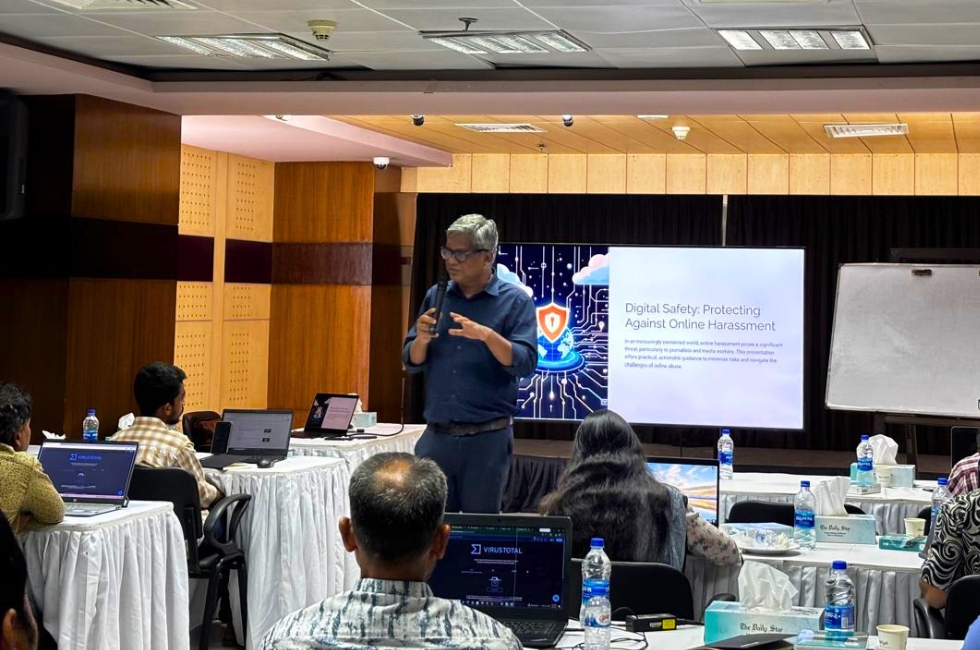
His experience is a reminder of why the Digital Hygiene Trainings by the Digital Safety School — an initiative of Digitally Right — have become a critical baseline for journalists across Bangladesh.
For participants like Marma, digital safety is not an abstract concept discussed in a seminar room; it is a survival mechanism in the field. The training, which has reached over 400 media professionals, aims to bridge the gap between high-risk reporting and the technical expertise required to navigate a digital-first world.
The landscape of risk
The challenges facing Bangladeshi journalists are often hidden in plain sight. According to a 2025 training report focusing on journalists working outside the capital, common digital threats include forgotten passwords, email and social media hacking, Facebook ID cloning, and persistent online harassment or bullying. For those in remote or politically sensitive areas, these digital vulnerabilities can quickly translate into physical risks.
In the training sessions, journalists were invited to share their own experiences with digital harassment. Many admitted to a cycle of insecurity: using easy-to-guess passwords to avoid the frustration of being locked out of their accounts and remaining largely unaware of how standard communication platforms might expose their locations or sources. The curriculum’s initial goal was to break this cycle, replacing convenience with a structured approach to “digital hygiene.”
From vulnerability to encryption
For many reporters, the most immediate revelation was the fragility of their existing habits. Ahsan Habib, a senior reporter at The Daily Star in Dhaka, recalls his previous approach to account security. “I used to give very easy passwords so that I could remember them,” he said. Through the training, he transitioned to using a password manager, a tool that was entirely new to him. “I have done that… now I have done that,” he said, noting that he no longer relies on memory for his security.
The shift in technical capability was even more pronounced for those operating in the “field level” environments. Md Suzon Ali, an apprentice staff correspondent for Daily New Age in Rajshahi, now employs a sophisticated layer of data protection that was taught during Digital Hygiene Training. “I use different tools to encrypt my data and capture pictures discreetly whenever I need.” For Ali, this is not about gadgetry but about the necessity of staying invisible. “These are very useful when it comes to working at the field level,” he added.
Marma in Bandarban echoes this. He describes how he now handles sensitive files during security checks. “When we go through those emergency times… how to keep these files hidden… these have been very useful,” he said, referring to the “hidden file” techniques he mastered during the sessions. For a journalist working where a single file could lead to a “threat to life,” these tools represent a tangible shield.
Building the right mindset
Beyond specific applications, the training focused on fostering a “mindset” of digital awareness — recognising that security is not a one-time setup but a continuous practice. Shamsuddin Illius, the Chattogram bureau chief for The Business Standard, shares a moment of realisation that occurred shortly after his training. While staying in a hotel, he found himself about to connect to the public Wi-Fi — a standard move for any travelling reporter. “I was in a hotel… I didn’t use that Wi-Fi,” he said. Instead, he used his own secure connection, a decision driven by the new “mindset” he developed. “A mindset has been built that we should at least check if it’s okay or not,” he noted.
For Shahin Akhter, a senior staff correspondent for New Age, the primary impact was an internal shift in her professional instincts. Although she found the VPN and password manager tools useful, she identifies the increase in her overall alertness as the most significant change. “My biggest takeaway is actually this: that you have improved my sense a lot and made me much more alert,” she said. “The matters of staying alert… it has taught me to be more alert”.
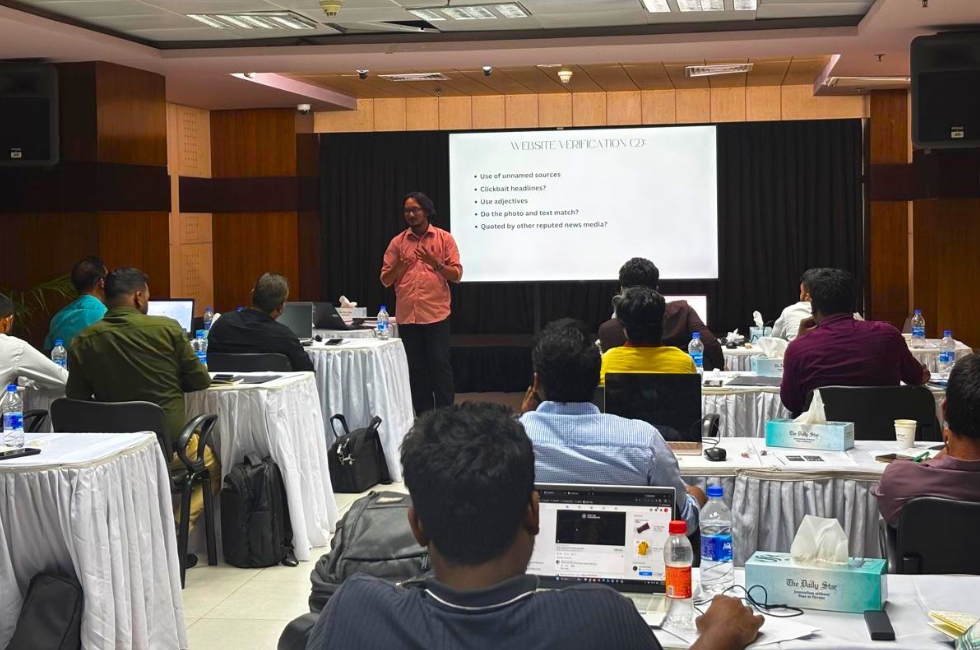
This alertness extends to how journalists consume and verify information. The sessions included a deep dive into fact-checking tools like InVID and reverse image searches, which have become essential in an era of AI-generated content and misinformation.
Md Tanvir Khondaker, a reporter for Independent TV based in Cumilla said he uses the InVID tool regularly to verify whether videos found on social media are AI-generated. He notes that the tool is a regular part of his workflow, stating, “We already have it installed. Because we need it frequently.” Senior reporter Ahsan Habib also highlighted the importance of archiving data from government websites, which often remove old files. “Government websites… when they get old, they take down data; they don’t keep it,” he said. “I can see it from there if I want; this is very important for me”.
The crucible: 2026 national elections
The practical utility of these trainings, and the accompanying hardware support, was put to an exhaustive test during the 2026 Bangladesh national election. To assist with the demands of election day reporting, Digitally Right provided journalists with essential hardware, including high-capacity power banks, pocket routers, and internet modems.
For a senior reporter at Sarabangla.net, who requested anonymity, the equipment was the difference between staying online and being silenced. “I worked a continuous 29-hour shift on election day,” she recalls. “As a senior reporter for an online news portal, the power bank was very helpful as a mobile backup… because on election day, we have to record a large amount of video and write news, all on the mobile”. The internet modem she received allowed her to bypass the common issue of network congestion at polling centres. “I could send news and video to the office quickly and without buffering,” she noted, crediting the tools with helping her perform better under extreme pressure.
In more remote areas, the hardware proved even more vital. Chingmepru Marma, a correspondent for Ekushey Television in Khagrachhari, used a pocket router to report from polling centres in inaccessible regions. “Because I could charge the mobile with the power bank, I could do news work on the mobile all day, give live feeds, and inform the office of the election results until late at night,” she reports. She even shared the router’s connection with colleagues who had no other way to transmit their stories.
Other journalists, like Sukanna Amir, who was stationed at the Election Commission for three days, found the high-capacity power banks indispensable. “Where I had to work, it was not possible to use a charger,” she explained. “I was able to use the power bank to charge the phone multiple times”. For these journalists, the training and the tools were not just about “digital hygiene”; they were about the logistics of maintaining a free press during one of the country’s most critical events.
A continuing need for vigilance
Despite this progress, the journalists remain clear-eyed about the evolving nature of the threats they face. The digital landscape is not static, and as technology advances, so do the methods of those who would intercept or disrupt a journalist’s work. Several participants expressed a desire for more in-depth training on emerging issues like artificial intelligence and more advanced data encryption.
For many, the transition from standard communication apps to secure, end-to-end encrypted platforms like Signal remains a work in progress, but the awareness of their previous vulnerability is a step forward. “We learned there just how insecure the apps we use everyday, like Messenger or WhatsApp, are,” one reporter noted. “After knowing this, it feels like we are in a very insecure position ourselves”.
Ultimately, the impact of the Digital Hygiene Trainings is measured in the quiet shifts in daily practice: in Suzon Ali’s encrypted folders, in Ahsan Habib’s archived data, and in the cautious way Shamsuddin Illius approaches a public Wi-Fi network. It is there, too, in the confidence of a female reporter who knows her device will stay powered through a 29-hour shift.
For the journalists who navigate the shifting risks of the field, these trainings have provided more than a set of apps or a piece of hardware. As Mong Sing Hai Marma reflects on his work in the hills, it is the ability to “verify” and “stay alert” that allows him to continue his work. In a profession where a simple digital slip-up can lead to real danger, that sense of security is the difference between being able to do their jobs and not.
The article was commissioned to Nasif Tanjim, a journalist at The Business Standard, by Digitally Right.