
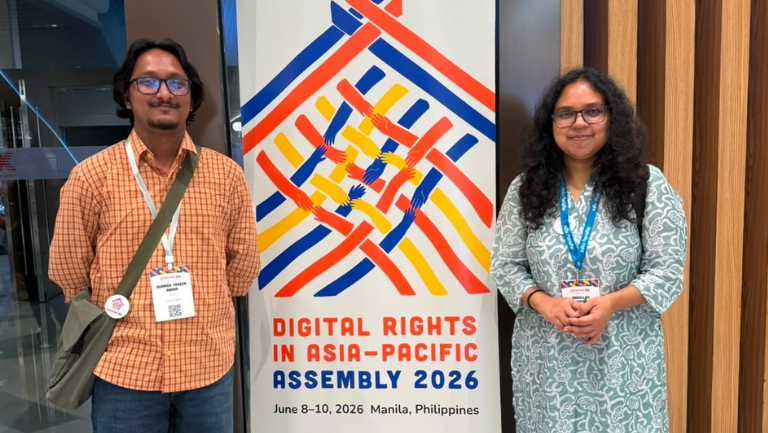
Abdullah Titir, Digitally Right’s Head of Research and Ahamed Yaseer Abrar, Research Officer, attended the 2026 Digital Rights Asia-Pacific Assembly (DRAPAC). Held from June 8 to 10 in Manila, Philippines, the event was co-hosted by Foundation for Media Alternatives (FMA), DAKILA Philippine Collective for Modern Heroism, and EngageMedia. The assembly focused on co-creating collective resources and shared digital infrastructure to address the region’s escalating digital rights challenges. During the convening, Titir participated as a speaker in an ideation workshop addressing information disorder across Asia.
Representing Digitally Right as the Bangladesh partner in the RAIDAR (Researching Asian Information Disorder and Responses) program, Titir emphasized that current infrastructures are drastically unequipped to manage the rapid spread of disinformation. She highlighted a critical concern: state regulations often restrict online freedom of expression rather than addressing the actual root causes of information disorder. Sharing insights from Dismislab, Titir noted that during the February 2026 election in Bangladesh, all contesting political parties engaged in spreading disinformation, exposing the failure of electoral bodies to enforce their own codes of conduct. Furthermore, media agencies remain limited by a lack of dedicated fact-checking units and a massive gap in coordinated digital literacy efforts.
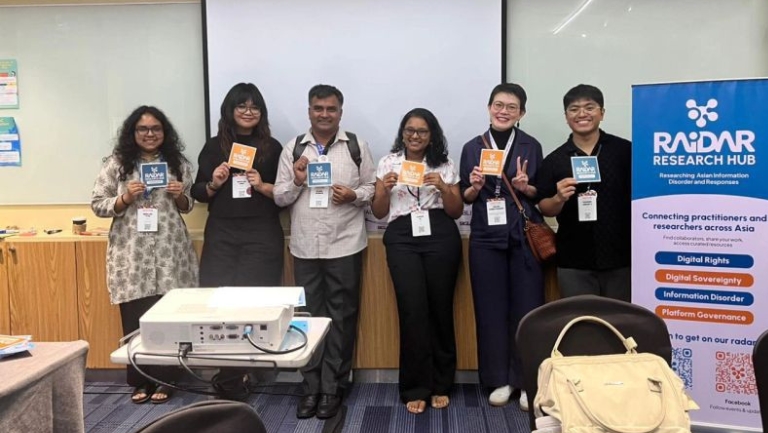
Safeguarding information integrity requires overcoming these challenges. Highlighting the value of regional solidarity, Titir stated:
“Digital rights groups fighting misinformation and disinformation in our region often operate in silos. This gathering has given us the opportunity to share what we do similarly and differently across the Asia Pacific region. Takeaways from this workshop will help us to explore collaborations for further research in this area, develop collective and region-specific strategies around fighting disinformation, and inform any policy advocacy taken up moving forward.”
To successfully advocate for policy changes, research must evolve beyond traditional academic molds to embrace innovative, community-centric formats. Moving forward, civil society must build robust multi-stakeholder coalitions and actively advocate for the shared digital infrastructures necessary to protect civic participation across the Asia Pacific.